Amarone della Valpolicella
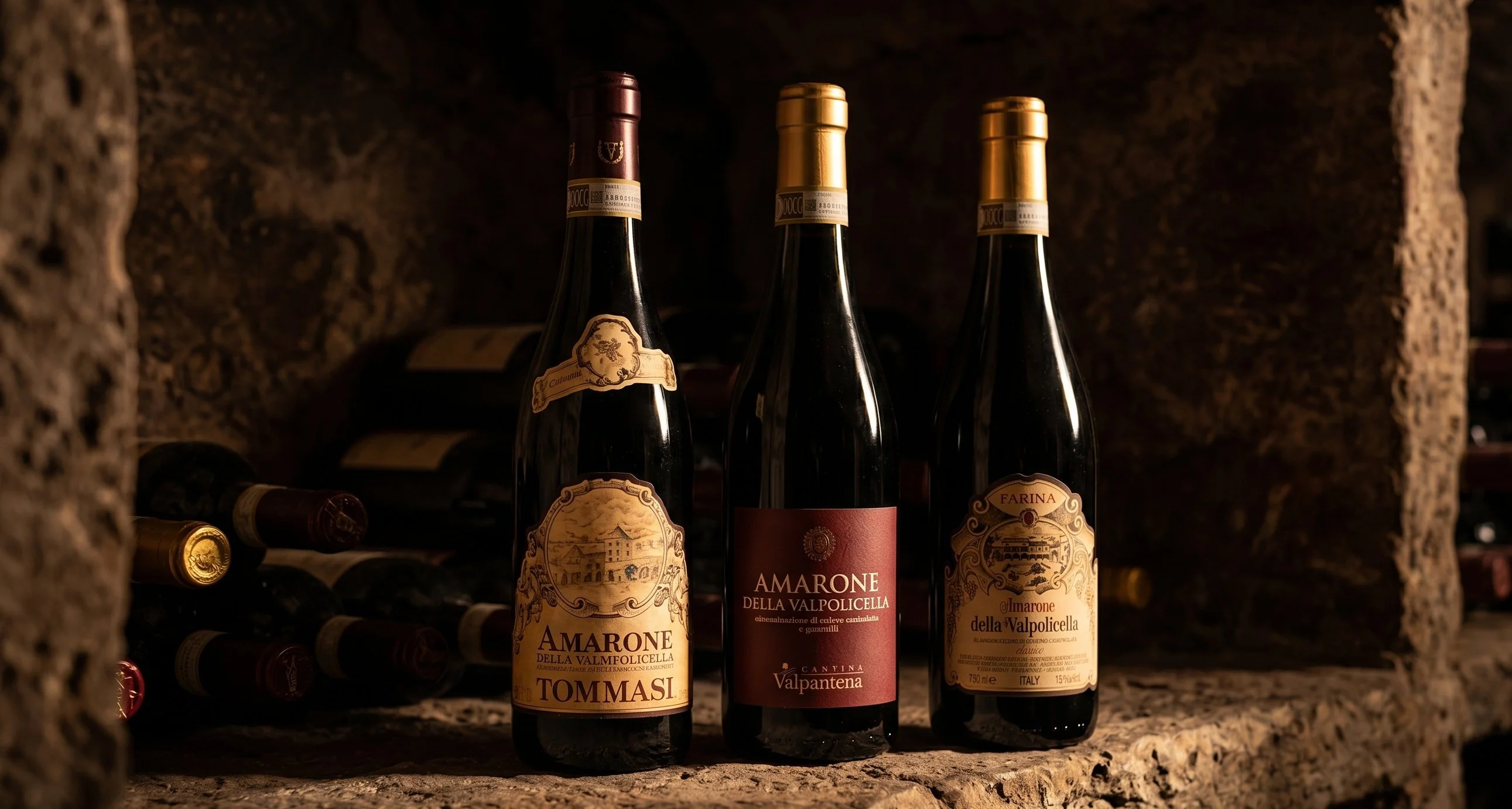
Amarone is the wine that defines Valpolicella. To make it, freshly harvested Corvina, Corvinone, and Rondinella grapes are laid on traditional wooden racks called arele in open lofts — the fruttai — where mountain air from the Lessini plateau circulates freely. Over 90 to 120 days, the grapes lose up to 30% of their weight through evaporation. Sugars concentrate. Flavours deepen. Fungi — primarily Botrytis cinerea in its noble form — can develop in humid conditions, adding further complexity.
The dried grapes are then pressed and fermented slowly over 30 to 50 days, consuming almost all residual sugar. Minimum ageing is two years for standard Amarone, four years for Riserva. Most top producers age considerably longer — five, six, seven years is not unusual before release.
In the glass: dried cherry, plum, bitter chocolate, espresso, leather, tobacco, and — in older vintages — tar, truffle, and dried rose. Structure is formidable; tannins are dry and very long. Alcohol rarely falls below 15%. These are wines built for decades.
Notable producers
Ripasso Valpolicella
Ripasso occupies a uniquely intelligent position in Italian wine. A base of Valpolicella Classico — already a pleasant, light red — is re-fermented on the spent grape skins left over from Amarone production. This second fermentation, the ripasso, extracts colour, glycerol, tannin, and aromatic compounds that the first wine never had. The result is a wine of genuine depth and generosity at a price point that makes it remarkable value.
The technique is ancient — references to it appear in Veronese records as early as the 17th century — but it was effectively rediscovered and modernised by Masi Agricola in the 1960s, whose brand Campofiorin popularised the style globally.
In the glass: ripe cherry, dried fig, a hint of vanilla and spice from the Amarone skins, with a velvet texture that distinguishes it immediately from a simple Classico. Serve at 16–17°C; decanting is rarely necessary but never harmful.
Notable producers
Valpolicella Classico
The most misunderstood wine in the valley. Because Classico lives in the shadow of Amarone's fame, it is often treated as a minor wine — a stepping stone rather than a destination. This is a mistake. A well-made Valpolicella Superiore from the right hillside, drunk young and slightly cool, is one of Italy's most reliably pleasurable table wines.
The Classico zone — the original, historic production area — is centred on the hills between Negrar, Marano, Fumane, Sant'Ambrogio, and San Pietro in Cariano. Soils here are predominantly volcanic basalt and limestone, giving the wines more mineral tension than Valpolicella produced further east. Look for the word Classico on the label; the broader Valpolicella DOC covers a much larger and more varied territory.
In the glass: sour cherry, dried herbs, bitter almond, a hint of earth, light tannins. Best served cool — around 14°C — with antipasto, grilled meats, or a generous plate of pasta.
Notable producers
Recioto della Valpolicella
Recioto is, historically, the wine that came first. Before anyone thought to let the appassimento ferment to dryness — and accidentally invented Amarone — there was Recioto: sweet, dense, made from the dried bunches of the highest vine rows (le recie, the ears of the bunch, which received the most sun). Local legend claims that Amarone was simply a Recioto forgotten by its maker, left to ferment until dry. The story is probably apocryphal, but it captures something true about the relationship between the two wines.
Recioto undergoes the same appassimento as Amarone, but fermentation is halted deliberately before all sugar is consumed — by cold, by sulphur, or simply by the wine's own rising alcohol. The result is intensely sweet but not cloying, with enough acidity and structure to balance the residual sugar.
In the glass: black cherry jam, dried fig, bitter chocolate, dried violets, with a long, bittersweet finish. Exceptional with aged Parmigiano, bitter chocolate, or very simply on its own after a long dinner.
Notable producers
The Grapes Behind the Wines
Corvina Veronese
The dominant variety, responsible for structure, colour, and the characteristic note of sour cherry and bitter almond. Late-ripening, resistant to botrytis, and the backbone of every Valpolicella wine.
Corvinone
Larger-berried cousin of Corvina, with which it is genetically distinct but aromatically similar. Particularly well-suited to appassimento, where its thick skin resists rot during the long drying period.
Rondinella
The supporting variety. Less aromatic than Corvina but highly productive and resistant to disease. Contributes freshness and colour, and is valued for its reliability across different vintages and elevations.